Inside the making of Canada’s first pay equity legislation
tvo.org – article
Nov 11, 2026. by Jamie Bradburn
75 years ago, post-war Ontario women finally got equal pay in the workplace. Did it work?
Leslie Frost believed that anti-discriminatory legislation signalled a democracy’s strength. He felt that such bills tested politicians and the public in ways where those who claimed to believe in democratic values would be “judged by millions of people throughout the world who are engaged…in the racial and political revolutions of our century.” Frost believed that “some day historians will record these days in which we live as days of great and fundamental changes in the thinking of mankind.”
During the winter of 1951, Premier Frost’s Progressive Conservative government introduced several bills in the Ontario legislature to address discriminatory employment practices. Among them was the Act to Ensure Fair Remuneration for Female Employees, Canada’s first attempt to enforce pay equity.
Efforts to address the wage gap between men and women had a long history in Ontario — in 1882, the Toronto Trades and Labour Council promoted “equal pay for equal work for both sexes.” Female teachers stormed a Toronto Board of Education meeting in 1904 to demand equal pay. After the Second World War, which saw a large influx of women into war-related industries, groups such as labour unions, women’s organizations, and the Co-operative Commonwealth Federation (the predecessor to the NDP) worked on plans to promote pay equity.
As 1951 began, there was movement on two fronts. Eamon Park (CCF, Dovercourt) introduced a private members’ bill regarding pay equity that went nowhere. On the government side, Frost met with Margaret Hyndman, who headed a recently formed committee of the Business and Professional Women’s Clubs of Ontario which provided the government with copies of current state and territorial pay equity legislation from the United States. The Tories formulated a bill based largely on New York’s law, which went into effect in 1946, and desired to align it with the United Nations’ Universal Declaration of Women’s Rights.
The government announced the first incarnation of the bill in late February 1951 but quickly withdrew it for further tinkering.
The revised act was introduced to the legislature on March 8, 1951. Section 2 contained the most important statements:
“No employer and no person acting on his behalf shall discriminate between his male and female employees by paying a female employee at a rate of pay less than the rate of pay paid to a male employee employed by him for the same work done in the same establishment.”
“A difference in the rate of pay between a female and a male employee based on any factor other than sex shall not constitute a failure to comply with this section.”
Administration of the act would be handed to a new independent tribunal. Complaints were to be sent in writing to the director of the Fair Employment Practices Branch, who had the power to ask the minister of labour to appoint a conciliation officer to investigate and determine a settlement. If this failed, a commission would conduct an inquiry.
The bill was introduced along the Act to Promote Fair Employment Practices in Ontario(which covered a broader range of discriminatory behaviour), and changes which gave women the right to sit on juries. After all three bills were introduced, Frost told the legislature that it was “a historic day in Ontario,” as “women are being given completely equal status and equal responsibility with men.”
Frost argued that restricting the act’s mandate to similar work within the same establishment was a practical approach, as salaries and wages varied across industries and different parts of Ontario. “While it was right and practicable within bounds to order equal pay for equal work,” Frost biographer Roger Graham observed, “prescribing equal pay for work of equal value was out of the question.”
Reaction among women’s groups was generally positive. Hyndman felt it was a step forward. “At present under many contracts in force in Ontario there has been a differential of as much as 30 cents an hour for the same work,” she noted. “It is one field in which collective bargaining has fallen down.” An unidentified woman told the Kitchener-Waterloo Record that as the number of career women increased, they required recognition of their abilities as equal to men, and that marriage should not constraint their earning ability.
It also found favour among business and labour officials. “It is logical to expect that people doing the same work with equal skill and speed should be paid equally, regardless of race, creed, colour, or sex,” observed P.M. Preston, the president of the Brantford Board of Trade. “There are many industries in which women operate the same machines as men and yet there is quite a difference in pay,” William Jenoves, president of the Toronto District Labour Council told the Toronto Star. He noted the bill aligned with organized labour’s efforts to advocate for pay equity, but worried there wouldn’t be enough government staff to enforce it.
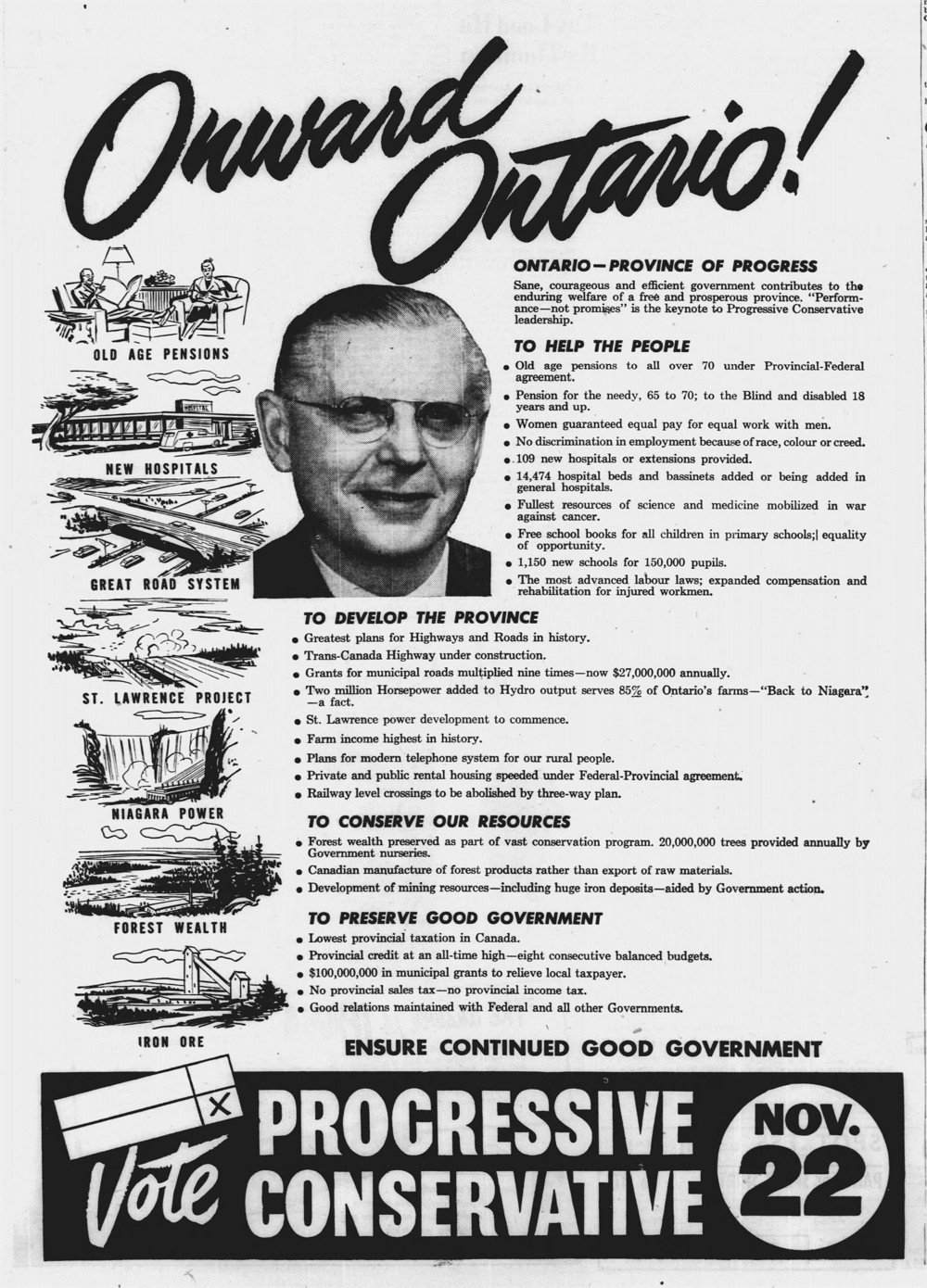
Progressive Conservative election campaign ad, Windsor Star, October 30, 1951.
Newspaper editorial pages felt the act was a boon for Frost, especially as a provincial election was expected later that year. “If the much-vaunted women’s vote in Ontario really means something, then it begins to look as though about the only cause that could remove Leslie Frost as premier of this province will be death from extreme old age,” joked the Owen Sound Sun-Times. The Windsor Star felt that Frost gave “further evidence that the ‘Progressive’ in Progressive Conservative has meaning, in Ontario at least.”
But the legislation wasn’t without critics. Municipal officials in Hamilton argued that women were only in the workforce for a few years before getting married, which would make investments in elements like female bathrooms and rest breaks a waste of money. These fears sounded ridiculous to Ellen Fairclough, the federal MP for Hamilton West, who told the Hamilton Spectator that if the city’s union agreements would be complicated by pay equity, “then it’s high time they were complicated on that score. I thought unions represented all the workers, not just the male members.”
“Nobody can say a woman is going to get married in a certain length of time. I don’t see how you can forecast how long a man or woman will stay at a job. After all, a man may get hit by a car, or have a heart attack and have to retire, forcing him to give up his job.” Fairclough would, six years later, become the first woman to serve as a federal cabinet minister.
In the legislature, the CCF was concerned that the legislation was too narrow in its scope. Park believed the wording was restrictive and would benefit few women, as he rejected the notion that work must be identical rather than comparable. He believed there were too many potential loopholes that employers could get around, such as the possibility women could be fired if they complained about financial discrimination.
Agnes Macphail (CCF, East York) felt the bill was “only a gesture” and would be improved if the term “comparable” was used instead of “same.” Her motion to amend the bill before second reading on March 12 failed by a 43-28 vote. Similar attempts to slow the Fair Employment Practices bill the next day also failed.
Subsequent attempts to delay the bill also failed. It gained assent on April 5 and went into effect on New Year’s Day 1952.
The major opponents, at least according to the press, were school trustees who believed in traditional gender roles. “I feel that this will take away the initiative of men,” declared Lorne Shantz, the president of the Ontario Public School Trustees Association. He felt male teachers took on more duties than women and deserved to be paid more, and envisioned a time when only men would teach because they didn’t leave the profession to get married, thus providing “greater continuity.” Shantz feared pay equity would create “unrest on the staff and indirectly the children will suffer.”
At a meeting of the Ontario Urban and Rural School Trustees Association in Guelph on March 14, the act was called “asinine” for its potential to cause headaches for educators and trustees. The Ontario Teachers’ Federation responded by issuing a statement declaring that “we are shocked at the suggestion that trustees entrusted with the duty of administering education in this democracy should feel that half the citizens of a country should be paid at a lower than the other half for doing the same job.”
When Frost kicked off the Progressive Conservatives’ election campaign in Kingston in October 1951, he listed pay equity and other anti-discriminatory policies as “a development and betterment in our way of life, in which it is out task to set an example to a troubled world.” The policy was mentioned in party and candidate ads for the campaign, which was a Tory landslide (the CCF collapsed from 21 seats to 2).
In the long run, the act had mixed results. Over its first decade, 124 complaints were received regarding 12 employees, none of which resulted in fines. The general wage gap only slightly narrowed, though some progress was made in education, even if some boards, especially in the Toronto area, already had equal pay policies in place by 1951. There was a sense that the business community had found it prudent not to oppose pay equity in public but quietly found ways not to embrace it.
The provisions of the act were incorporated into the Ontario Human Rights Code by 1962, alongside increased educational efforts as the 1960s went on. Pay equity was then incorporated into a new Employment Standards Act in 1968 and slightly expanded to incorporate “equal skill, effort, and responsibility.” Further revisions were made in 1974 to broaden the meaning of “same work.” Finally, modern pay equity became enshrined in Ontario law with the enactment of the Pay Equity Act in 1987.
Sources: Old Man Ontario by Roger Graham (Toronto: University of Toronto Press, 1990); the March 9, 1951 edition of the Brantford Expositor; the March 9, 1951, March 13, 1951, March 15, 1951, and March 16, 1951 editions of the Globe and Mail; the March 9, 1951 and March 12, 1951 editions of the Hamilton Spectator; the March 9, 1951 and March 15, 1951 editions of the Kitchener-Waterloo Record; the March 13, 1951 edition of the North Bay Nugget; the Summer 1989 edition of the Osgoode Hall Law Journal; the March 10, 1951 edition of the Owen Sound Sun-Times; the March 9, 1951 edition of the Toronto Star; and the March 8, 1951, March 12, 1951, and October 5, 1951 editions of the Windsor Star
https://www.tvo.org/article/inside-the-making-of-canadas-first-pay-equity-legislation
Tags: economy, ideology, jurisdiction, standard of living, women
This entry was posted on Friday, November 13th, 2026 at 12:38 pm and is filed under Equality History. You can follow any responses to this entry through the RSS 2.0 feed. You can skip to the end and leave a response. Pinging is currently not allowed.
Leave a Reply
 Recent Comments